
Williamson County City Directory Shelves
Williamson County does not have one published, countywide run of city directories with verified years and publishers. The public materials identify several reliable collections instead. Round Rock Public Library keeps its genealogy and local-history collection on the north side of the third floor, including the Williamson County Genealogical Society collection. Most material does not circulate. Start there for printed directories or reverse volumes, but ask Adult Services for a call number and the years actually on hand. The public library pages do not identify a complete Polk, Morrison, or Fourmy run, so a careful search records the volume title and year rather than assuming a gap is a missing household.
| Collection | Years | Where held | Access |
|---|---|---|---|
| Round Rock genealogy and local history materials | Exact directory run not published | Round Rock Public Library, third floor | In-library; most materials do not circulate |
| Austin American-Statesman Historical Newspapers | 1871-1980 | Round Rock Public Library database | Library card or onsite public computer |
| Texas Digital Sanborn Maps for Round Rock | 1885-1925 | Library research database | Online through the library |
| Williamson County Genealogical Society library | Exact runs not published | Society and library collection | Society or library access |
| Williamson County Historical Society microfilm | Dates vary by item | Historical Society inventory | On-site details not published |
| Federal census schedules | 1790-1950 | NARA and library resources | Public schedules under the 72-year rule |
Use a printed listing for a date and an address. Use the census, deed, or appraisal layer to test what that listing means. The two kinds of sources answer different questions.
Williamson County Directory Room
The Round Rock Public Library is the clearest public entry point for a Williamson County city directory search. Its genealogy collection covers the United States, Southern states, Texas, Williamson County, and nearby counties. The library combines its holdings with the Genealogical Society collection, so a missing result in a general catalog does not end the inquiry. Visitors can use public computers, while a library card opens some remote resources. Adult Services can be reached at 512-218-7003, and the collection is at 200 E. Liberty Ave., Round Rock. The second and third floors close 15 minutes before the building closes.
The Round Rock Public Library genealogy collection shows the physical setting for this Williamson County historical research.
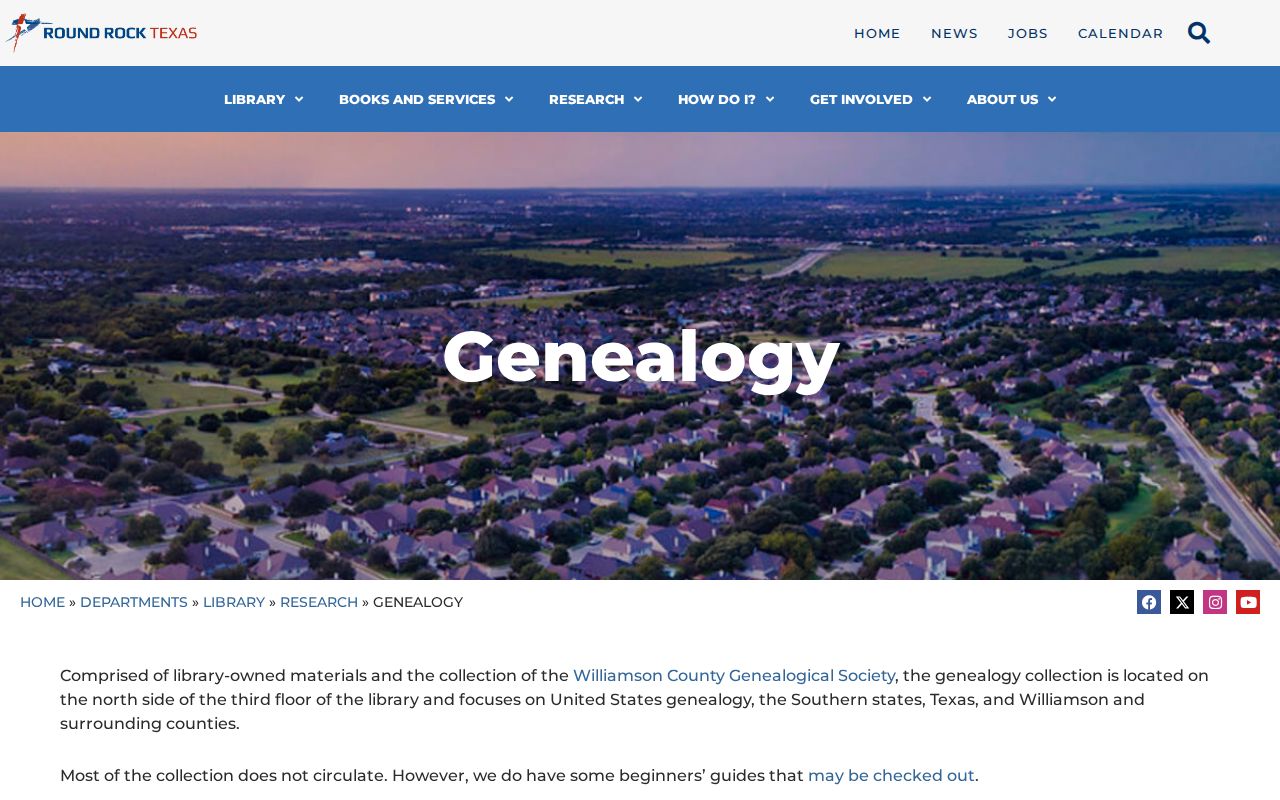
A shelf search works best with a written name variant, a place name, and an approximate year. That gives staff a concrete request without asking them to conduct an open-ended search.
Note: Record the title page, city, year, page, and section whenever a directory entry becomes part of a family-history trail.
Williamson County Directory Databases
Library databases fill the years when a city directory is absent or a name is hard to read. The Round Rock research list includes Ancestry Library Edition, Fold3, HeritageHub, HeritageQuest Online, NewsBank, Newspapers.com, and free databases from the New England Historic and Genealogical Society. The historical Statesman collection can supply notices and local context from 1871 through 1980. Search an address, surname, initials, married-name variant, or a nearby business. A newspaper item may date a move more closely than a yearly book, but it still needs to be weighed against the original publication and any later records.
The library research categories bring those newspaper, genealogy, county-history, and Sanborn resources together.
These services are companions to a cited volume, not a substitute for it. Save the database name and the search date along with any result.
Reading Williamson County Directory Entries
No official online source exposed an actual Williamson County city directory entry during research. A standard Texas directory format is still useful as an expectation, not as proof of a local publisher’s practice. Read the publisher’s abbreviation key before expanding any mark. A name may be followed by a spouse or household relation, a printed occupation or organization, a home address, a phone number, and notation for a home, rooming, boarding, widow, apartment, or room entry. That entry may identify a person at an address for that edition, but it does not establish ownership, current presence, or every person in a household.
| Name line | Record spelling, initials, suffixes, and any household relation exactly as printed. |
|---|---|
| Address | Capture house number, street, apartment or room marker, and the directory year. |
| Printed role | Keep any occupation or organization wording as a transcription, not an identity conclusion. |
| Abbreviations | Check the front-matter key for marks such as home, room, boarding, or widow notation. |
| Source citation | Save publisher, city, volume year, page, and whether the entry was alphabetical or address-ordered. |
- Criss-cross directory
- An address-ordered section, when a volume has one, used to check the listing printed for a street address.
- Householder index
- An index arranged around the principal household listing rather than every possible person at an address.
- Abbreviation key
- The publisher’s explanation of shortened words and symbols, usually in the opening pages of the volume.
Williamson County Sanborn Directory Window
Round Rock’s Texas Digital Sanborn Maps cover 1885 through 1925. They do not name every occupant. Instead, they show buildings, land use, streets, and neighborhood context. That makes them useful beside a Williamson County historical listing when a house number looks unfamiliar, a block changed shape, or a business address needs a physical setting. Compare the map edition date with the volume year. A mismatch may show a new building, a renamed business, or simply a source created at another time.
When an old address reaches a modern parcel question, use the Williamson County streets reference for the current address-keyed record path rather than treating the map as an ownership record.
Note: A Sanborn sheet supports a building and street-context finding, while a deed or appraisal record is needed for a parcel ownership conclusion.
Williamson County Directory Microfilm
When a household drops out of the historical trail, the Williamson County Historical Society inventory provides other local clues. It names cemetery histories, lot-owner records, veterans buried by cemetery, church minutes, family Bibles, pioneer-family notes, and some census microfilm. Specific examples include Gum Springs United Baptist Church minutes from 1849 through 1881, First Christian Church Marion memorabilia from 1892 through 1899, and an Aikman Cemetery history and audit from 1845 through 1889. These are collection leads, not an assertion that each person appears in a searchable index.
The Williamson County Historical Society microfilm inventory identifies the kinds of material available for deeper research.
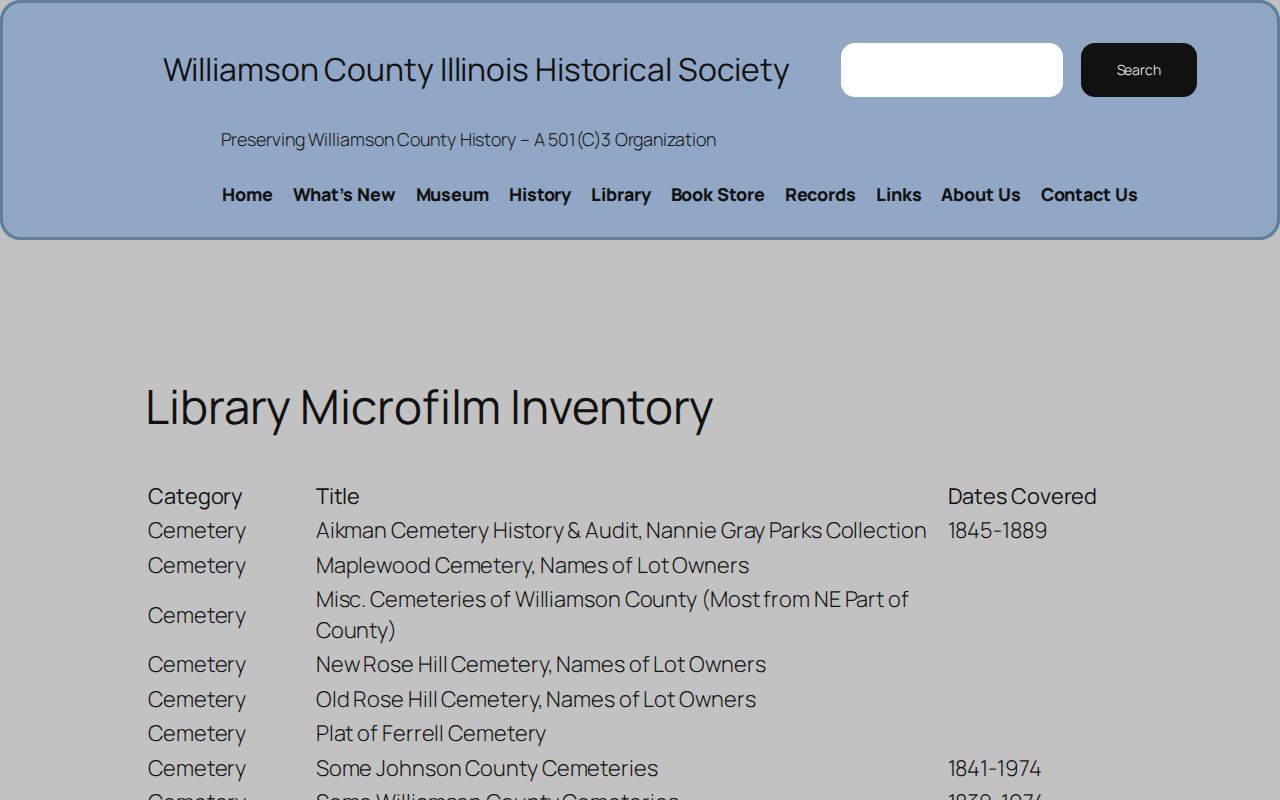
Because the public inventory does not publish research hours or fees, contact the historical society before planning an on-site visit and describe the collection item sought.
Williamson County Genealogy Society
The Williamson County Genealogical Society maintains a research library through purchases, donations, exchanges, books, periodicals, microfilm, and electronic media. It publishes The Roundup and The Chisholm Trail, and it offers programs that can help a researcher work through surname variants, pioneer-family notes, cemetery transcription, and local research methods. Meetings are listed for 7 p.m. on the third Thursday at Round Rock Public Library except August and December, with visitors welcome. The society is a useful place to ask about a directory title or a local collection, not a substitute for the record custodian.
The Williamson County Genealogical Society describes its research-library and publication work.

Its books and microfilm can add context when a directory entry is abbreviated, a surname changes form, or a family connection needs another local source.
Tracing Williamson County Directory Households
A household trail starts with the nearest known city directory year, then moves out in both directions. Search the alphabetical section first. If a reverse or criss-cross section is present, compare the address listing after you have copied the name entry. Use spelling variants, initials, married names, compound surnames, and likely transcription errors. Pair each useful directory date with a federal census release. NARA makes public individual schedules through 1950 under the 72-year rule, allowing a reader to compare street, house number, household members, ages, and listed occupations without assuming that two similar names are the same person.
- Choose a person, address, or local organization and identify the closest available directory year.
- Copy the listing and the volume citation, including every abbreviation that needs later checking.
- Search earlier and later editions for moves, name changes, and changes in household notation.
- Compare the closest public census schedule, using street and household members to test the match.
- Use newspapers, probate material, cemetery records, or church material to close a trail that ends between editions.
A name disappearing can reflect a move, a death, a changed spelling, an unlisted residence, or a volume gap. It is a prompt for another source, not a final answer.
Williamson County Courthouse Records
Local record geography matters when historical research reaches the nineteenth century. Williamson County was organized in 1848. The courthouse story moved from early meetings and a log courthouse to a frame residence, then a stone courthouse, before the historic Georgetown courthouse opened in 1911. Early records may therefore be identified by office and book rather than a modern building address. The 1981 Williamson County courthouse-records inventory is a digitized finding aid with 205 pages and an index. It documents county and district clerk, tax, justice, county court, sheriff, and election record groups, but it is not a live replacement for the clerk.
- 1848: Williamson County was organized and early county officials were elected.
- Late 1848 or early 1849: a log courthouse followed the county’s earliest meetings.
- 1850 and 1857: courthouse work moved to a frame residence, then to a stone courthouse.
- 1911: the historic Georgetown courthouse opened, creating the later landmark familiar to many researchers.
That history explains why a printed directory is one layer in a much older local record system. Date every source, preserve the citation, and confirm a legal record with the office that holds it.